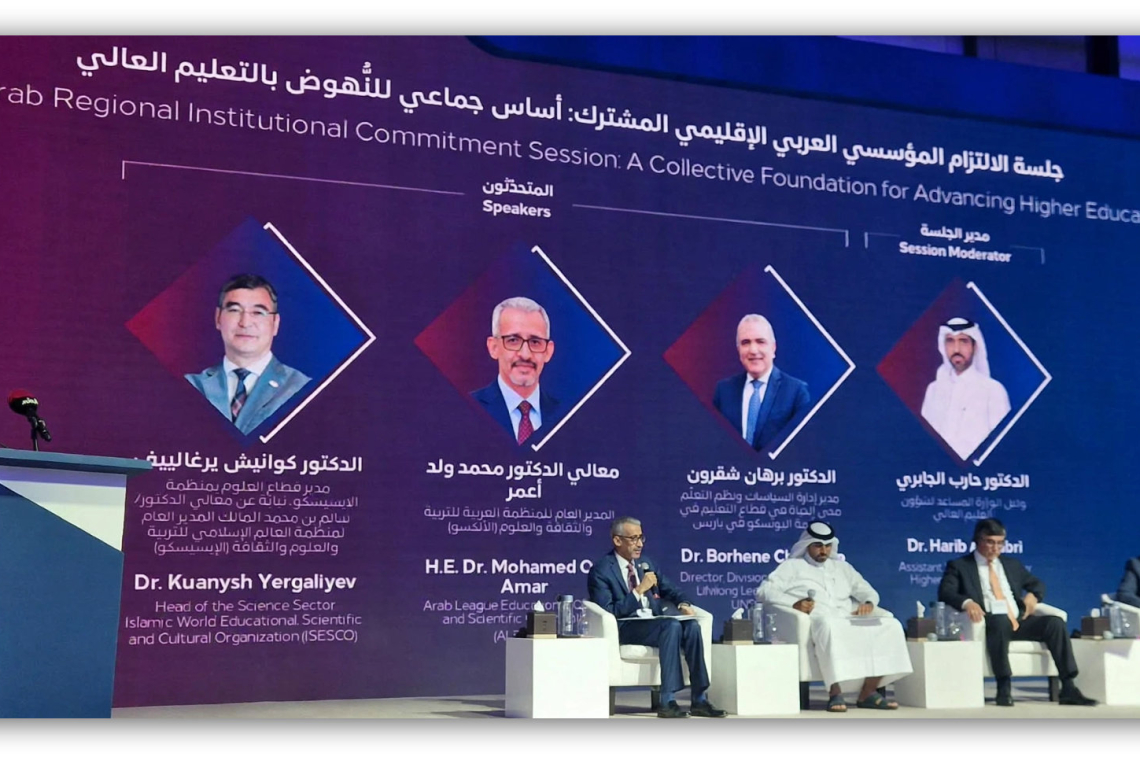
H.E. Dr. Mohamed Ould Amar, Director-General of ALECSO, participated in the high-level opening session of the 5th UNESCO Conference on Higher Education in the Arab States, hosted by the State of Qatar on November 2–3, 2026.
In his address, the Director-General highlighted the role of Arab organizations in supporting higher education systems. He noted that the current state of higher education in the Arab region reflects two contrasting realities: one characterized by progress, with Arab universities securing positions among the top 200 in international university rankings, and another marked by crises, as wars have damaged higher education infrastructure in several countries. In this regard, he called on relevant organizations to move beyond the exchange of expertise and develop practical mechanisms to support these institutions.
The Director-General outlined the major challenges facing higher education in the Arab world, including disparities in research funding among countries, fragmented research efforts on shared issues such as water scarcity, differences in academic curricula and terminology, limited academic mobility, and difficulties in achieving mutual recognition of academic qualifications. He also drew attention to the limited presence of the Arabic language in international scientific publishing, with its share not exceeding 3%, as well as the absence of a standardized reference system for Arabic scientific terminology, an issue that ALECSO is working to address.
Furthermore, he addressed the issue of brain drain and ways to benefit from the expertise of Arab scholars abroad, highlighting ALECSO’s successful “Visiting Scholars and Arab Migrant Minds” programme. This initiative aims to harness the expertise of Arab scholars and researchers living abroad to strengthen research capacities in Arab countries and establish networks connecting Arab universities and research institutions with international universities and research bodies where Arab experts are based.
The Director-General also raised the issue of the absence of joint Arab programmes for student and researcher exchanges, similar to Erasmus and Fulbright. He presented a vision centered on achieving knowledge sovereignty for Arab countries, ensuring the quality of university education, equipping students with the competencies required by the global labor market, and strengthening the capacity of universities and research centers to anticipate future developments. He concluded by calling for the establishment of a Common Arab Higher Education Area that prioritizes academic mobility, promotes scientific research to address shared challenges, and encourages the development of practical and actionable solutions.