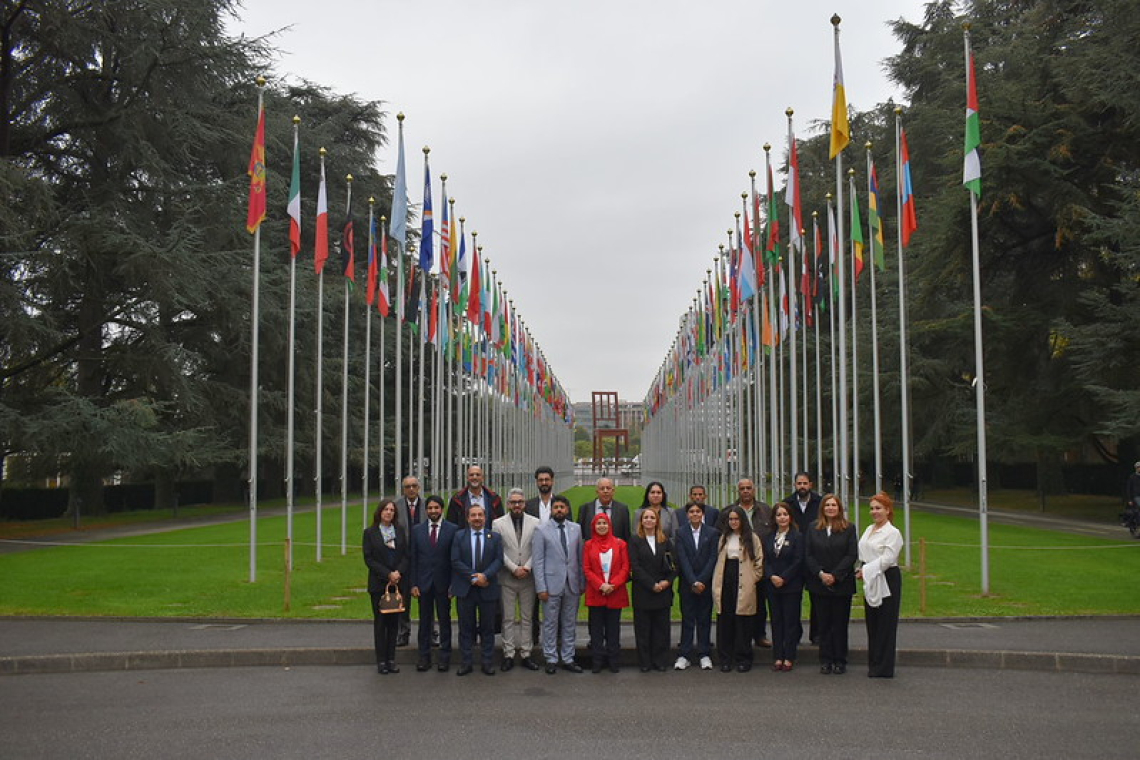
The Arab League Educational, Cultural and Scientific Organization (ALECSO) took part in the international conference on “Arabic Language Education for Diaspora Children in the Digital Age,” held in Geneva on October 20–21, 2026. The conference was organized by ALECSO and the Hamsat Sama'a International Cultural Organization, with the participation of the Global Peace Message Foundation.
The ALECSO delegation to the conference was headed by Dr. Rami Iskander, Director of Education.
In a recorded message, the Director-General of ALECSO, H.E. Dr. Mohamed Ould Amar, reaffirmed the great importance ALECSO attaches to the Arabic language and to Arab children, particularly those in the diaspora, as well as its support for initiatives designed to promote Arabic language education and strengthen the cultural identity of younger generations.
The Director-General emphasized the importance of the Arabic language as a fundamental pillar of Arab cultural and civilizational identity. He stressed that teaching Arabic to diaspora children goes beyond acquiring linguistic skills to strengthening their sense of cultural belonging, reinforcing their connection to their mother tongue, and enabling younger generations to remain attachment to their civilizational heritage. He also highlighted the importance of harnessing modern technology and artificial intelligence (AI) to develop Arabic language teaching methods that respond to the needs of children in multilingual and multicultural environments and enhance the presence of Arabic in the digital world.
The participation of ALECSO’s Education Department in the conference forms part of its efforts to develop educational practices, promote innovation in education, and expand Arab and international cooperation in Arabic language education. Particular attention is given to Arab diaspora children and to developing educational solutions that address their linguistic and cultural needs.
For his part, Dr. Rami Iskander commended, in his address, the role played by the Hamsat Sama'a International Cultural Organization in supporting cultural and educational initiatives aimed at serving the Arabic language and strengthening its presence in Arab and international communities. He emphasized that holding the conference in Geneva reflects the importance of bringing together the efforts of Arab and international institutions to keep pace with digital transformations in education. He also hailed the efforts of the Global Peace Message Foundation in supporting the conference and contributing to its success. Furthermore, he underscored the importance of contributions from cultural and community-based institutions in promoting the values of peace and coexistence and strengthening the ties of Arab diaspora children to their language, culture, and civilizational identity.
The conference addressed key issues related to the identity and cultural belonging of diaspora children, innovation in Arabic language education, applications of artificial intelligence in education, and multilingual educational models. It also explored the opportunities and challenges presented by digital platforms, as well as child protection requirements in online learning environments.
The conference concluded with the launch of an international initiative entitled “The Geneva Declaration on the Future of Arabic Language Education for Diaspora Children in the Digital Age.” The initiative aims to strengthen cooperation among educational, cultural, and technological institutions; support the development of intelligent digital learning tools that leverage AI applications; establish a sustainable international cooperation network; and develop an open educational database to serve Arab diaspora children.