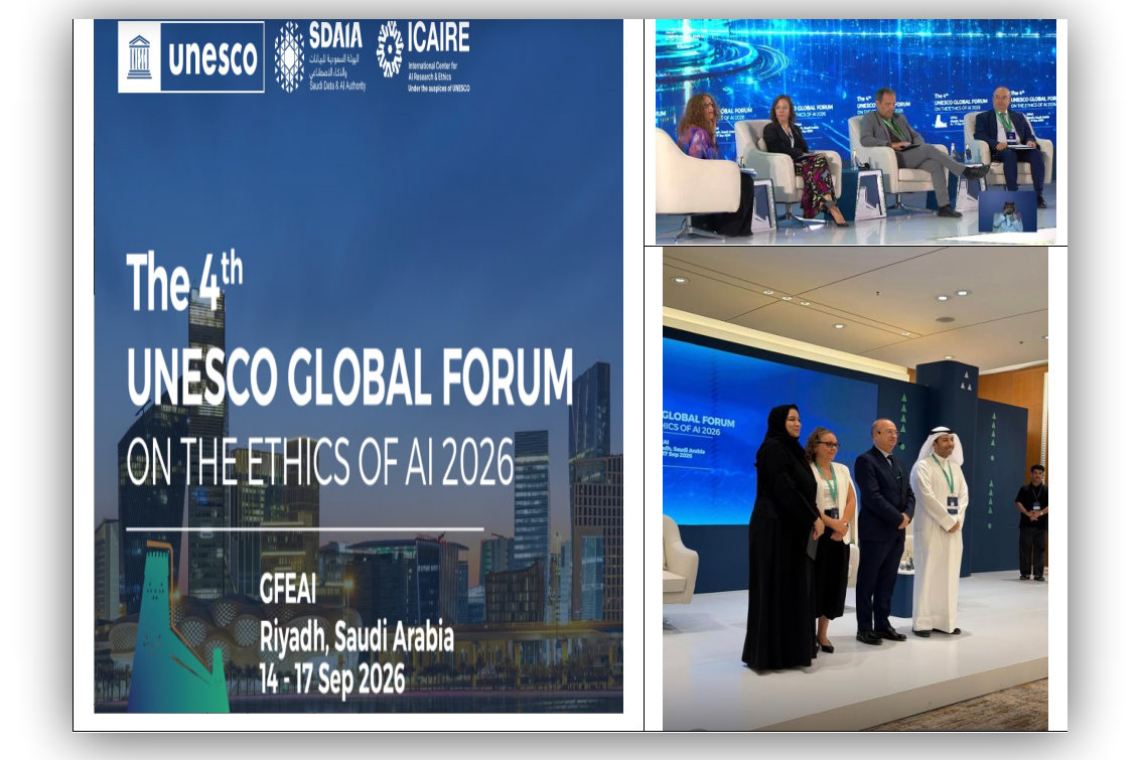
The Arab League Educational, Cultural and Scientific Organization (ALESCO) participated in the fourth edition of the UNESCO Global Forum on the Ethics of AI, hosted by Riyadh, Saudi Arabia, from September 14 to 17, 2026, under the theme “International Cooperation for Responsible AI.”
The high-level international event brought together ministers, policymakers, senior officials, experts, academics, and representatives of international organizations and the public and private sectors to discuss the future of AI ethics and governance and ways to translate principles into practical implementation.
The Kingdom of Saudi Arabia hosted the Forum in partnership with UNESCO, with the Saudi side represented by the Saudi Data and Artificial Intelligence Authority (SDAIA) and the International Center for AI Research and Ethics (ICAIRE).
The Forum featured broad international participation, with more than 100 international speakers across 30 panels and workshops addressing various dimensions of AI ethics and governance. It also brought together ministers and international representatives from over 60 countries, reflecting growing international interest in developing shared frameworks for responsible, safe, inclusive, and sustainable AI governance.
ALESCO was represented by Dr. Mohamed Jemni, Director of ICT, who participated in two panels addressing ethical AI governance and ways to move from principles to practical implementation.
In the first panel, titled “Converging Global Visions for Ethical AI Governance,” Dr. Jemni emphasized the importance of taking linguistic and cultural diversity, as well as the plurality of knowledge traditions, into account when developing global AI governance frameworks. He stressed that language, culture, and knowledge are not secondary considerations in AI governance, but fundamental dimensions of fairness, inclusion, and trust. He also highlighted the importance of strengthening the presence of the Arab region in the global dialogue on AI governance, underscoring the need for better representation of the Arabic language in its various forms and dialects, as well as Arab cultural and knowledge contexts, within AI systems.
In this context, he highlighted ALESCO’s experience in developing the “Arab Charter on AI Ethics” in Education, Culture, and Science, stressing the importance of aligning global principles with regional, national, and sector-specific particularities while adhering to human rights and relevant international frameworks.
In the second panel, titled “From Principles to Practice: Operationalizing Ethical AI Governance,” Dr. Jemni stressed that the challenge today is no longer limited to reaching agreement on the principles that should govern AI—such as fairness, transparency, accountability, inclusion, safety, and human oversight—but lies primarily in translating these principles into practical measures that can be implemented, measured, and monitored. He also addressed emerging challenges associated with the rise of Agentic AI systems, which are increasingly capable of autonomous planning, decision-making, action, and the use of digital tools. He emphasized that greater autonomy for AI systems must not, under any circumstances, entail a reduction in human responsibility. He concluded by underscoring the importance of making ethical impact assessment and continuous monitoring an integral part of the AI system lifecycle, from design and procurement through deployment and use, and ultimately to evaluation and follow-up.
ALESCO’s participation in the Forum reaffirms its continued efforts to promote responsible, ethical, and inclusive AI in the Arab region and to strengthen the presence of Arab perspectives in the international dialogue on AI governance. These efforts take into account linguistic, cultural, and knowledge diversity and contribute to translating ethical principles into actionable policies in the fields of education, culture, and science.