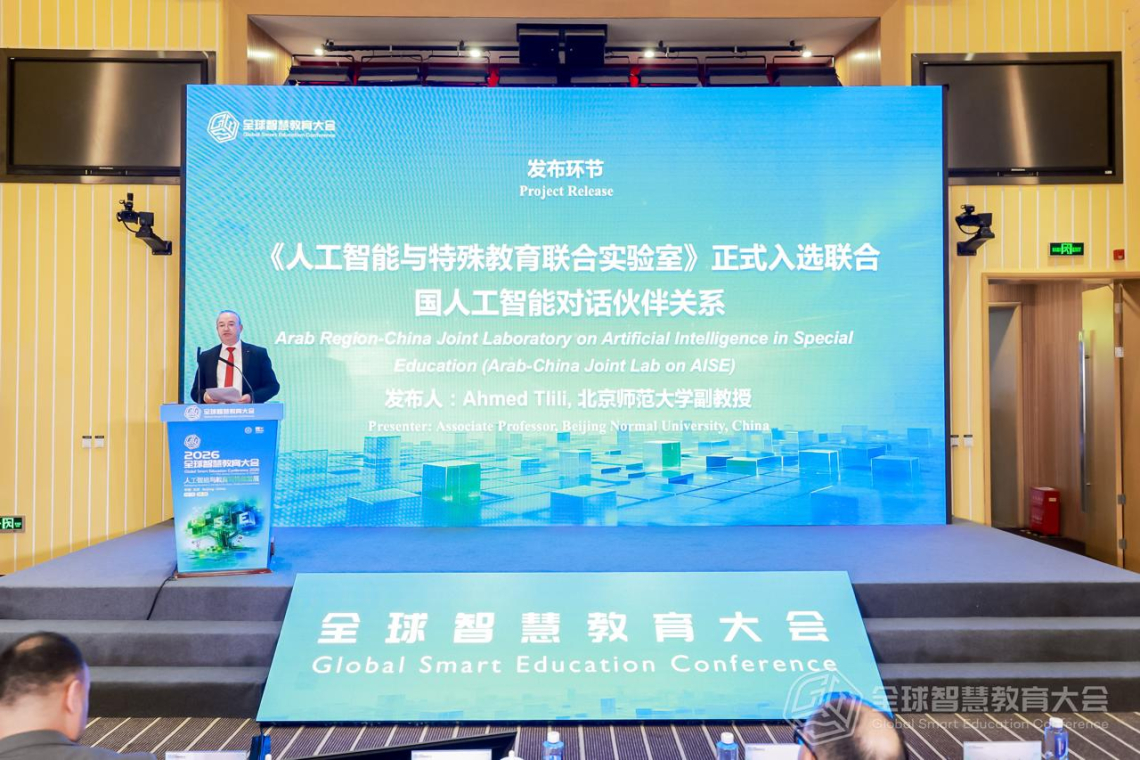
As part of the Global Smart Education Conference (GSE 2026), held in Beijing, China, from August 18 to 20, 2026, the Arab League Educational, Cultural and Scientific Organization (ALECSO), jointly with the Beijing Normal University (BNU) and with Millennium@EDU as co-organizer, held a high-level session entitled: “AI for Inclusive and Sustainable Education: High-level Dialogue on Capacity Building, Equity and Special Needs.”
The session brought together experts, officials, and representatives of international and academic institutions and organizations to discuss ways of harnessing artificial intelligence (AI) to develop more inclusive, equitable, and sustainable education systems. Particular emphasis was placed on capacity-building, reducing digital and educational gaps, and expanding learning opportunities for persons with disabilities and special educational needs.
Dr. Mohamed Jemni, Director of ICT at ALECSO, opened the session by conveying the greetings of H.E. Dr. Mohamed Ould Amar, Director-General of ALECSO, to all participants. He underscored the importance of the session in advancing international dialogue and cooperation on the responsible and inclusive use of AI in education.
Dr. Jemni noted that the rapid development of AI offers unprecedented opportunities to improve the quality of education, personalize learning pathways, and develop tools and solutions that are more capable of responding to the diverse needs of learners. At the same time, he emphasized that realizing these opportunities depends on the ability of countries and institutions to ensure equitable access to technology and build the capacities required to use it in a responsible and effective manner.
Dr. Jemni stressed that AI should not become a new factor widening the digital and educational divide among countries and communities. Rather, it should promote international cooperation, digital solidarity, knowledge and expertise-sharing, and technology transfer; thereby ensuring that developing countries and the most vulnerable groups can benefit from the rapid transformations taking place in education. He highlighted the significant role that AI technologies can play in advancing inclusive education and expanding learning opportunities for persons with disabilities and special educational needs, by developing more flexible, personalized, and accessible educational solutions. He underscored the necessity of keeping human beings—their rights, dignity, and needs—at the heart of the process of digital transformation and AI use in education.
This session forms part of the cooperation between ALECSO and Beijing Normal University in the fields of smart education, artificial intelligence, and digital transformation. It reflects the commitment of both parties to strengthening bridges of scientific and intellectual collaboration between the Arab countries and China, exchanging expertise and successful experiences, and developing joint initiatives and projects in these domains.
This cooperation is further embodied in the “Arab Region–China Joint Laboratory on Artificial Intelligence in Special Education”, an initiative led by ALECSO in partnership with Beijing Normal University, Kuwait College of Science and Technology, and Millennium@EDU Sustainable Education, with the participation of the Laboratory for Information and Communication Technologies and Electrical Engineering at the University of Tunis, and Nazra wa Ishara Foundation which supports deaf persons.
The initiative aims to establish a joint platform for research, development, innovation, and capacity-building in the use of AI in special education and inclusive learning. It seeks to develop smart, inclusive, reliable, and human-centered solutions that can improve learning opportunities and access to knowledge for persons with disabilities and special educational needs, while strengthening knowledge exchange, expertise-sharing, and research cooperation among Arab, Chinese, and international partner institutions.
The initiative has received significant international recognition, having been accepted and published among the initiatives featured on the United Nations’ AI Dialogue Partnerships Hub, as part of the Global Dialogue on AI Governance. This recognition reflects the importance of Arab–Chinese and international cooperation as a model for the responsible and inclusive use of AI in support of education and sustainable development, particularly for persons with disabilities and special educational needs.
The session provided an opportunity to exchange views, experiences, and expertise on capacity-building and the development of policies and practices that can maximize the benefits of AI in education. Participants also emphasized the importance of combining technological innovation with equity, responsibility, and inclusion when shaping the future of education systems.
The session and the initiatives associated with it reflect ALECSO’s commitment to expanding its Arab and international partnerships and strengthening cooperation with leading institutions in education, AI, and technology. They also provide sustainable platforms for dialogue and the exchange of knowledge and expertise, ultimately serving the goal of promoting quality, equitable, inclusive, and accessible education for all.