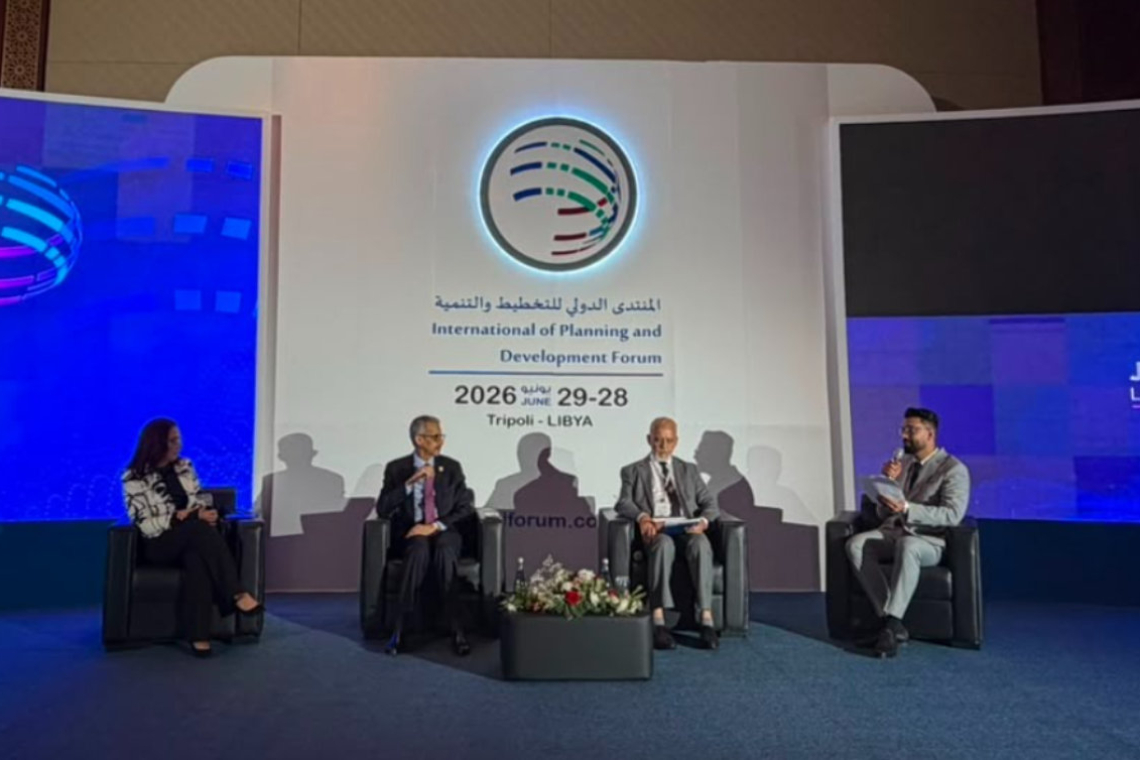
H.E. Dr. Mohamed Ould Amar, Director-General of ALECSO, participated, on 28 June 2026, in the opening session of the International Planning and Development Forum, organized by the Ministry of Planning in collaboration with the Arab Planning Institute (Kuwait) and the Institute of Planning in Tripoli. The event was attended by H.E. Prime Minister Abdul Hamid Dbeibah, alongside several ministers, senior officials, and experts in planning and development.
In his opening address, the Prime Minister emphasized that state-building begins with a clear vision and sound planning, noting that the Forum serves as a platform for sharing expertise, building partnerships, and developing practical visions capable of addressing challenges while promoting stability and development. Planning, he added, is no longer merely an administrative option but is now a national imperative and a fundamental instrument for safeguarding stability, achieving sustainable development, and improving citizens' quality of life.
The Prime Minister further indicated that the Government of National Unity has, from the outset, adopted an institutional approach centered on strategic planning. This approach involves developing an institutional planning system, aligning public expenditure with national priorities, strengthening governance and transparency, and enhancing government performance. He stressed that development is a comprehensive national project built on good governance, the optimal use of resources, and the effective implementation of plans to deliver tangible results.
H.E. Dr. Mohamed Ould Amar, Director-General of ALECSO, participated as a keynote speaker in the first session of the Forum entitled “Social Planning and Human Capital Development: The Role of the State in a Market Economy.” The session examined the current state and future prospects of human capital development, as well as its social costs in the context of ongoing economic transformations.
The Forum was designed to promote a culture of strategic planning, facilitate the sharing of expertise and experiences among national and regional institutions, strengthen capacity-building in the fields of planning and development, and discuss contemporary development policies, while formulating practical recommendations to enhance institutional efficiency and advance sustainable development in Libya.
The Forum featured a series of workshops, panel discussions and specialized sessions covering key themes, including development planning, investment and economic development, the green economy, and the Sustainable Development Goals (SDGs), with the participation of prominent experts and specialists.