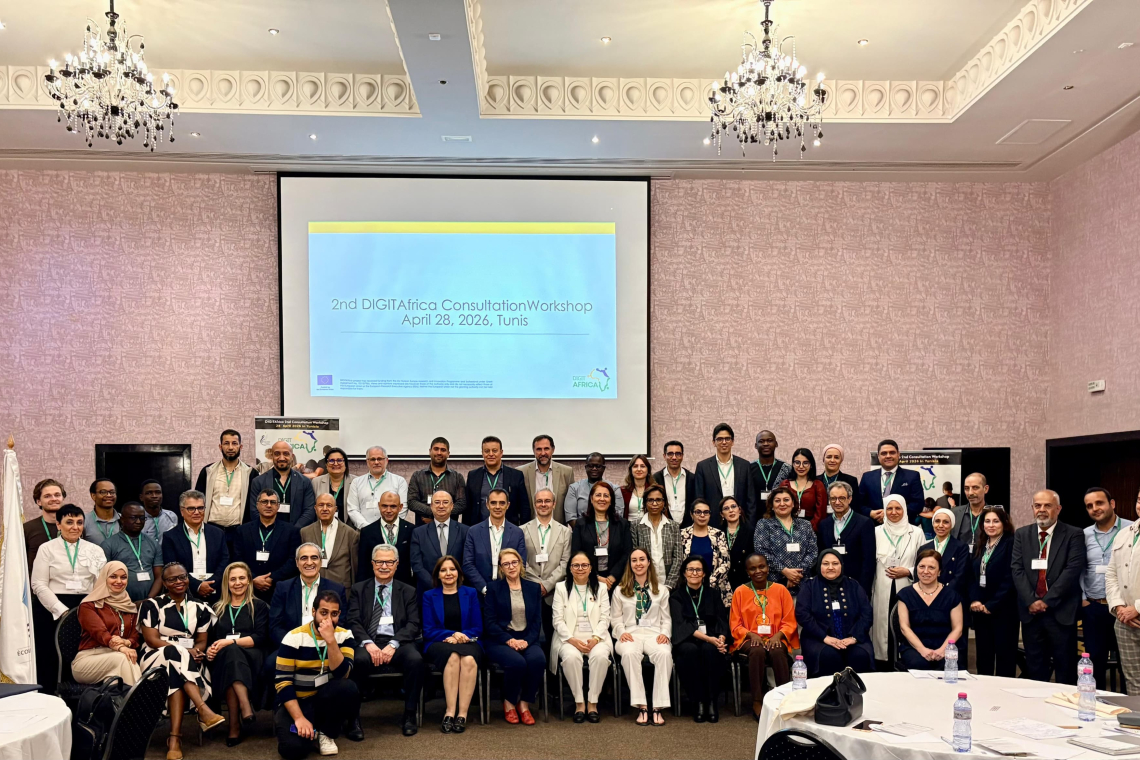
The Arab League Educational, Cultural and Scientific Organization (ALESCO - ICT Department) took part in the Second DIGITAfrica Consultation Workshop, held in Tunis on April 28, 2026.
The workshop was organized within the framework of the DIGITAfrica project, funded by Horizon Europe and Switzerland. It brought together several partners from Africa and Europe, including the University of Manouba and the National School of Computer Sciences, alongside Sorbonne University which coordinates the DIGITAfrica project, in addition to a number of academic and research institutions and relevant regional and international organizations. The project seeks to promote a shared vision for building sustainable African digital research infrastructures and to enhance Africa–Europe cooperation in the fields of research and digital innovation.
Dr. Mohamed Jemni, Director of ICT at ALESCO, chaired and moderated the third panel titled: “National Perspectives on Digital Research and Innovation.” The panel addressed national and institutional experiences in digital research and innovation, with participation from experts and representatives of institutions from Senegal, Benin, and Tunisia. It also featured presentations on AI strategies, centers of excellence, innovation ecosystems, the role of universities, as well as cloud infrastructures and high-performance computing in support of higher education and scientific research.
In his opening remarks, Dr. Jemni underlined the importance of strengthening African digital sovereignty through developing open, sustainable, and interoperable digital infrastructures, while linking national initiatives to a shared African vision capable of transforming skills, ideas, and experiences into practical projects with tangible impact.
This participation reflects ALESCO’s commitment to supporting digital transformation and innovation in education, higher education, and scientific research, and to enhancing Arab, African, and international cooperation in building inclusive and sustainable digital ecosystems that respond to development priorities and foster knowledge production and expertise-sharing.