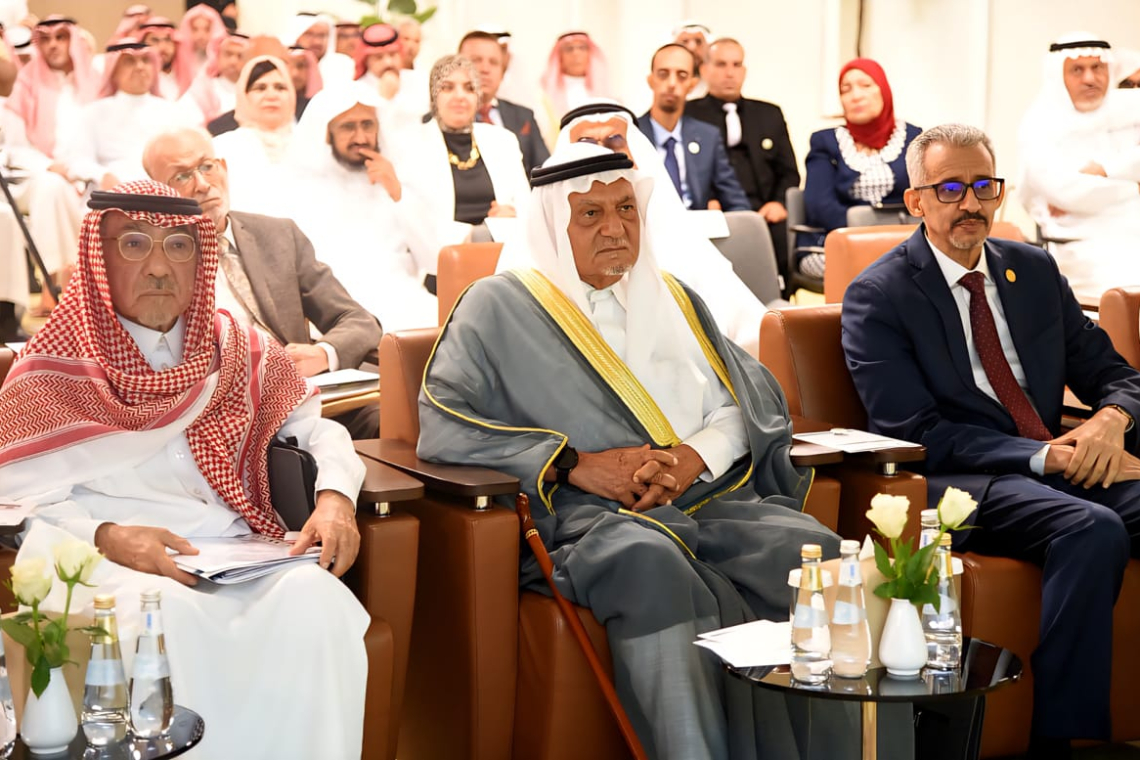
H.E. Dr. Mohamed Ould Amar, Director-General of ALECSO, took part in the “Arabic Manuscript Day” event, held on October 5, 2025 in Riyadh, Saudi Arabia, in collaboration between the Institute of Arabic Manuscripts (affiliated with ALECSO) and the King Faisal Center for Research and Islamic Studies.
The event was attended by HRH Prince Turki Al-Faisal, Chairman of the Board of Directors of the King Faisal Center, and HRH Princess Dr. Maha bint Mohammed Al-Faisal, Secretary-General of the Center, along with representatives from various institutions, universities, and specialists in Arabic manuscripts.
In his opening remarks, Prince Turki Al-Faisal emphasized that it was no coincidence that the King Faisal Center was hosting this event. He recalled that more than fifty years ago, on February 19, 1973, King Faisal bin Abdulaziz (may he rest in peace) received a delegation from the Institute of Arabic Manuscripts in Riyadh, near the location of the current event. That meeting, he said, “was not just a formal reception, but a spark of thought that carried a significant message, where King Faisal highlighted the status of the Arab heritage as a core component of identity and an enduring source of authentic culture.” He concluded by stressing that “the Arabic manuscript is not a legacy to be celebrated only on special occasions, but rather a lasting civilizational asset and a cultural record that speaks for us, bearing in its pages the features of the Arab individual in his pursuit of civilizational advancement.”
For his part, Dr. Mohamed Ould Amar delivered a speech in which he highlighted the great importance ALECSO places on Arabic manuscripts. He indicated that ALECSO annually celebrates the “Arabic Manuscript Day” and awards prizes for outstanding contributions to its preservation, the manuscript being the memory and intellectual wealth of the Arab nation. He emphasized the significance of this year’s edition, held in partnership with the King Faisal Center, noting that this collaboration will culminate in the signing of a cooperation agreement between the two sides to support the Arabic manuscript. The Institute of Arabic Manuscripts, established in 1946 and acting as ALECSO’s specialized body in this field, will be tasked with implementing the agreement's provisions.
This year’s “Arabic Manuscript Day” program was distinguished by its diverse and rich scientific and cultural content. It involved academic sessions and the honoring of relevant prominent figures in recognition of their significant contributions to the preservation of the Arab heritage.