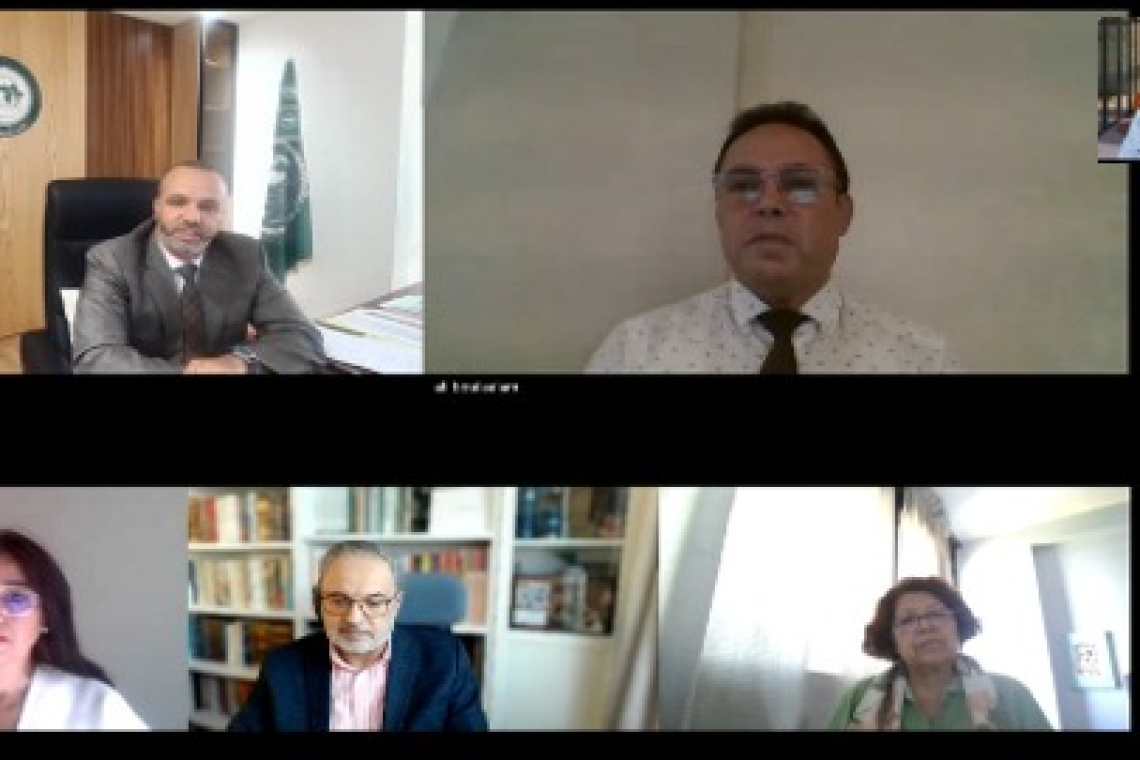
The Arabization Coordination Bureau, a Rabat-based subsidiary institution of ALECSO, hosted the fourth session of its Cultural Salon on September 26, 2025, in Rabat, Morocco, titled “From Language to Thought: The Challenges of Artificial Intelligence and the Future of the Arabic Language". The session featured the participation of Dr. Mumin Alannan, Director of “Lisan of Arabic Language” in London, and Dr. Ali Bouallam, Professor of Higher Education and Director of the Humanities and Digitalization Laboratory at Moulay-Ismail University in Meknes.
In his opening remarks, Dr. Mourad Rifi, Director of the Arabization Coordination Bureau, emphasized that digital sovereignty is a fundamental pillar in strengthening Arab cultural and intellectual identity. He highlighted the importance of keeping pace with rapid technological transformations to ensure the presence of the Arabic language in the global digital space.
Dr. Mumin Alannan stressed that Arabic is facing an existential challenge amid the prevalence of AI technologies, and highlighted the need to preserve its status not merely as a tool for communication but also as a language of thought, creativity, and civilizational identity. Despite being spoken by over 400 million people, he noted, the digital presence of Arabic remains limited compared to other languages. He warned of grammatical and semantic errors generated by AI models, and called for the involvement of linguists in correcting them. He also called for enriching databases with Arab cultural and heritage contexts, as well as for leveraging AI in developing smart educational curricula, digitizing heritage, producing interactive dictionaries, and building instant translators that respect cultural nuances. He concluded by urging Arab institutions to strengthen partnerships between linguists and programmers in order to turn AI into an opportunity to reintroduce Arabic as a global language.
Dr. Ali Bouallam focused on the challenges of digital transformation, including building a unified Arab digital environment that integrates language and culture, and transitioning from traditional knowledge management to digital knowledge engineering based on algorithms. He emphasized that the development of Arabic language processing—from manual methods to generative models relying on big data—opens new prospects for producing innovative content. He pointed out that the Arabic digital content needs qualitative development to align with AI applications such as machine translation, sentiment analysis, and information mining.
The Salon concluded by emphasizing the urgent need to intensify Arab efforts to develop digital content. This involves launching strategic projects such as creating a joint Arab search engine and forming technological blocs capable of competing with major global tech conglomerates.